90 Marks in MHT CET 2026 — Percentile, Rank & Real College Options
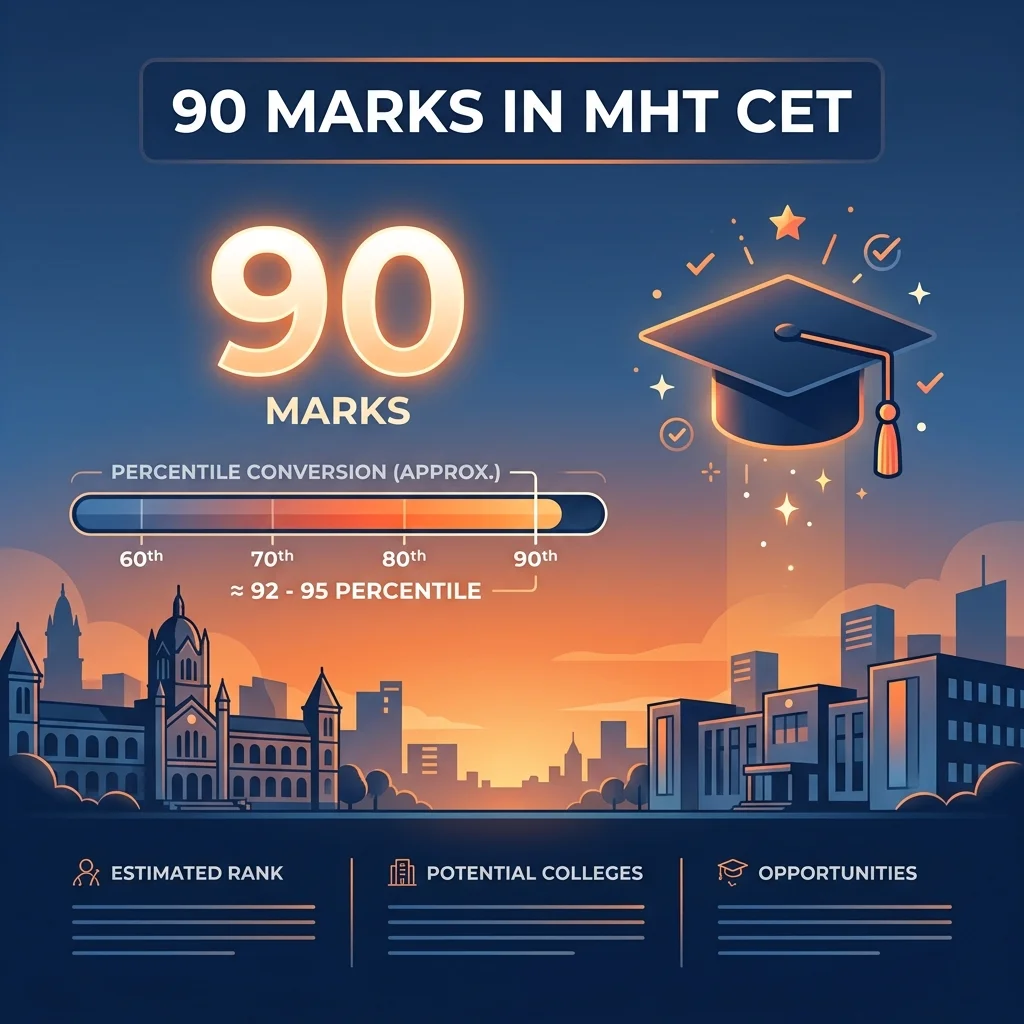
A score of 90 marks in MHT CET 2026 puts you squarely in a range that many students find confusing — it's not high enough to guarantee a top college, but it's absolutely high enough to get into genuinely good engineering colleges across Maharashtra if you approach counseling the right way.
The problem is that most guides either give vague percentile ranges without explaining why, or list colleges without telling you which branches are actually realistic at this score. This guide does neither. We'll break down exactly what your 90 marks means in percentile terms, show you how that translates to a CRL rank, and then map out specific colleges and branches that are genuinely within reach — not aspirational fantasies.
What Percentile Can You Expect for 90 Marks?
MHT CET doesn't work like school exams where marks directly determine your standing. Because the exam is conducted in multiple sessions over several days, with each session having a different difficulty level, your final percentile is calculated after normalization — a statistical process that adjusts raw scores across shifts to make them comparable.
This means two students who both scored 90 marks in different shifts can end up with different percentiles. Here's what the historical data from 2023–2025 shows for a 90-mark score:
| Shift Difficulty | Expected Percentile for 90 Marks | What This Means |
|---|---|---|
| Hard shift | 86 – 90 percentile | Fewer students crossed 90, boosting your relative standing |
| Moderate shift (most common) | 82 – 86 percentile | Standard outcome for a typical exam day |
| Easy shift | 78 – 82 percentile | More students scored high, compressing percentiles |
For planning purposes, use 82–86 percentile as your realistic baseline. This is the moderate-shift scenario that applies to the majority of test-takers. If your shift was on the harder side, consider yourself pleasantly surprised with your final result.
Why Your Percentile and Rank Are Different Numbers
Students often confuse percentile with rank, and this confusion can lead to poor choice filling. Here's the critical distinction:
Percentile is a relative measure — 85 percentile means you scored better than 85% of all candidates. Rank is an absolute position — it tells you exactly how many students scored above you.
With approximately 6 lakh students appearing for MHT CET, here's what your percentile translates to in terms of CRL (Combined Merit List) rank:
| Percentile | Approximate CRL Rank | Students Above You |
|---|---|---|
| 88 percentile | ~72,000 | ~72,000 students scored higher |
| 85 percentile | ~90,000 | ~90,000 students scored higher |
| 82 percentile | ~1,08,000 | ~1,08,000 students scored higher |
This rank range (roughly 70,000 to 1,10,000) is where your seat allocation will happen. Maharashtra has approximately 1.5 lakh CAP seats across all colleges, so even at rank 1,00,000, you will get a college — the question is which college and which branch.
⚠️ Don't panic at a rank of 80,000–1,00,000. Maharashtra has 856 colleges with 1.5 lakh+ seats. A rank of 1,00,000 does not mean you won't get a good college. It means you need to fill choices strategically and focus on realistic options — not reach for COEP while ignoring 50 good mid-tier colleges that will give you a solid education.
Which Colleges Are Realistic at 90 Marks?
Based on 2024–25 CAP Round closing cutoffs, here are genuinely realistic college options across Maharashtra at the 82–88 percentile range. These are not aspirational — these are colleges where the closing cutoff fell within or below your expected percentile range in at least one of the three CAP Rounds last year.
- MIT Academy of Engineering (MITAOE), Alandi
- JSPM Rajarshi Shahu College of Engineering
- NBN Sinhgad School of Engineering
- Indira College of Engineering & Management, Pune
- Dr. D.Y. Patil Institute of Technology, Pimpri
- Vidyalankar Institute of Technology, Wadala
- Fr. Conceicao Rodrigues College of Engineering
- Terna Engineering College, Nerul
- Pillai College of Engineering, New Panvel
- A.C. Patil College of Engineering, Kharghar
- Priyadarshini College of Engineering
- G.H. Raisoni College of Engineering
- Rajiv Gandhi College of Engineering
- KDKCE (K.D.K. College of Engineering)
- Walchand Institute of Technology, Solapur
- KIT's College of Engineering, Kolhapur
- SSBT COET, Jalgaon
- SRES COE, Kopargaon (Ahmednagar)
For OPEN category students, branches like Mechanical, Civil, Electrical, and Electronics & Telecommunication (ENTC) are generally more accessible at this percentile range than Computer Science. CS seats at these colleges typically have closing cutoffs of 88–92 percentile, which is slightly above the typical 90-mark outcome.
However, if you belong to a reserved category (OBC, SC, ST, NT), your effective options expand significantly. Category-specific cutoffs at many of the above colleges for CS and IT fall in the 75–82 percentile range, which is well within your reach.
✅ Use the PredictCollege.in predictor and set your actual category before reviewing options. The difference between OPEN and OBC cutoffs at mid-tier colleges for CS can be 8–12 percentile points — which at your score range makes a very significant difference to your available choices.
Branch-Wise Realistic Expectations at 90 Marks
Here's an honest breakdown of what you can realistically target by branch at the 82–88 percentile range in OPEN category. This is based on 2024–25 CAP closing cutoff data:
| Branch | Accessibility at 82–88%ile (OPEN) | Notes |
|---|---|---|
| Computer Science (CS) | Difficult at top mid-tier colleges | CS at PCCOE, VIT, PICT needs 92–96%ile. Possible at smaller colleges. |
| Information Technology (IT) | Possible at mid-tier colleges | IT cutoffs typically run 3–5 percentile points below CS at same college. |
| AI & Data Science / AI & ML | Good availability | Newer branches with lower cutoffs. Good career prospects. Worth targeting. |
| Electronics & Telecom (ENTC) | Comfortable range | Strong option at well-placed colleges. ENTC has good placement records. |
| Mechanical Engineering | Wide availability | Accessible at most colleges in this range. Market demand for Mech is recovering. |
| Electrical Engineering | Wide availability | Good for power sector, core jobs, PSU exams like MSETCL, MAHADISCOM. |
| Civil Engineering | Very wide availability | Excellent for government jobs, infrastructure, and MPSC/UPSC technical roles. |
A Smarter CAP Round Strategy for 90 Marks
The way you fill your choices in the CAP Round will have more impact on your outcome than any single mark you scored in the exam. Here's what most guides don't tell you about choice filling at this score range:
1. Fill More Than 50 Choices — Ideally 100+
Many students in this percentile range fill 15–20 choices thinking that covers everything. It doesn't. The CAP system processes thousands of students in merit order, and seats at good colleges in popular branches fill quickly. Having 100+ choices gives the algorithm more options to work with in your favour. The system will never give you a lower-ranked option if a higher-ranked one has seats available — so adding more choices only helps, never hurts.
2. Don't Put CS at Top Colleges as Your First 10 Choices
This is a very common mistake. If your first 10 choices are all Computer Science at colleges with 92–96 percentile cutoffs, and you get no allotment in Round 1, you've missed the opportunity to get a good seat in a decent branch at a realistic college. Place 3–4 reach choices at the top, then transition to your realistic matches for the next 30–40 slots.
3. Use "Accept & Upgrade" After Round 1
If Round 1 gives you a decent but not ideal allotment, choose Accept & Upgrade — not Reject. This keeps your current seat secured while allowing you to try for better in Round 2. Rejecting a Round 1 allotment is one of the riskiest decisions a student in this range can make.
4. Look Beyond Pune and Mumbai
Students who restrict themselves to Pune and Mumbai are competing with the highest concentration of applicants in those districts. Government colleges in Chhatrapati Sambhajinagar, Nashik, Solapur, and Kolhapur often have lower cutoffs for the same quality of education, especially in government-aided institutions where the fees are significantly lower.
How Normalization Can Work in Your Favour
MHT CET's normalization process sometimes creates unexpected outcomes for students who appeared in harder exam slots. Here's a concrete example based on historical data:
Real Scenario from 2024 Data
In MHT CET 2024, two students both scored 90 marks. Student A appeared in a relatively easy morning slot where the average score was 78 marks. Student B appeared in a harder afternoon slot where the average was 64 marks. After normalization, Student A received an 83 percentile while Student B received an 89 percentile — a 6 percentile point difference from the exact same raw score. Student B could access colleges that were completely out of reach for Student A.
The lesson here is not to make assumptions about your percentile until the official results are declared. Many students with 90 marks who appeared in harder slots have been pleasantly surprised by their final percentile.
Frequently Asked Questions
Is 90 marks enough to get a government college in Maharashtra?
It depends on the specific government college and branch. Government-aided colleges (not fully government) like Walchand, Government College of Engineering Chhatrapati Sambhajinagar, or GCoE Karad have branch-specific cutoffs that vary widely. Non-CS branches at many government-aided colleges close in the 80–90 percentile range, making 90 marks genuinely competitive for those options. Pure government (fully state-funded) colleges like COEP and VJTI have much higher cutoffs for most branches.
Can I get Computer Science with 90 marks?
In OPEN category, getting CS at well-known colleges is difficult at 90 marks since most close above 90 percentile. However, CS at smaller or newer private colleges in Tier-3 cities often closes at 80–85 percentile. If you belong to OBC, SC, or ST category, CS at mid-tier colleges is very much accessible at 90 marks since category cutoffs are typically 10–15 percentile points lower than OPEN cutoffs.
Should I consider AI & Data Science or AI & ML branches instead of CS?
These newer branches introduced in recent years currently have lower cutoffs than traditional CS because they are newer and students are less familiar with them. However, their curriculum is highly relevant to current industry demand — covering machine learning, data engineering, and Python-based development. For students who can't access CS at their preferred college, AI & DS or AI & ML is genuinely a strong alternative, not a consolation prize.
What if I don't get any allotment in all three CAP rounds?
At 82–88 percentile, not getting any allotment in all three rounds is extremely unlikely if you fill choices properly. With 1.5 lakh seats available and roughly 6 lakh appearing (many of whom don't register for CAP), most students in this percentile range get allotted by Round 2. The main risk is rejecting a good allotment in Round 1 and then getting nothing better in Round 2. Always have a backup plan and use Accept & Upgrade rather than Reject.
Does the college's NAAC grade matter more than its ranking?
For most practical purposes — fees, faculty quality, and recognition by employers — NAAC accreditation is a more reliable quality signal than private ranking surveys, which are often influenced by paid listings. Prefer colleges with NAAC A or A+ grades over unaccredited colleges even if the latter claims a higher position in some ranking list. NAAC grades are publicly verifiable on the NAAC website.
A score of 90 marks in MHT CET 2026 is a legitimate starting point for a solid engineering career in Maharashtra. The students who get the best outcomes at this score range are not the ones who scored highest — they are the ones who researched their options carefully, filled intelligent choices, and avoided the common mistakes that cost otherwise capable students their best-fit college.
Start with the PredictCollege.in college predictor — enter your percentile, select your category, and get a full list of realistic options sorted by safety level. Use that as the foundation for building your CAP Round choice list.