100 Marks in MHT CET 2026 — Your Percentile, Rank & Best College Strategy
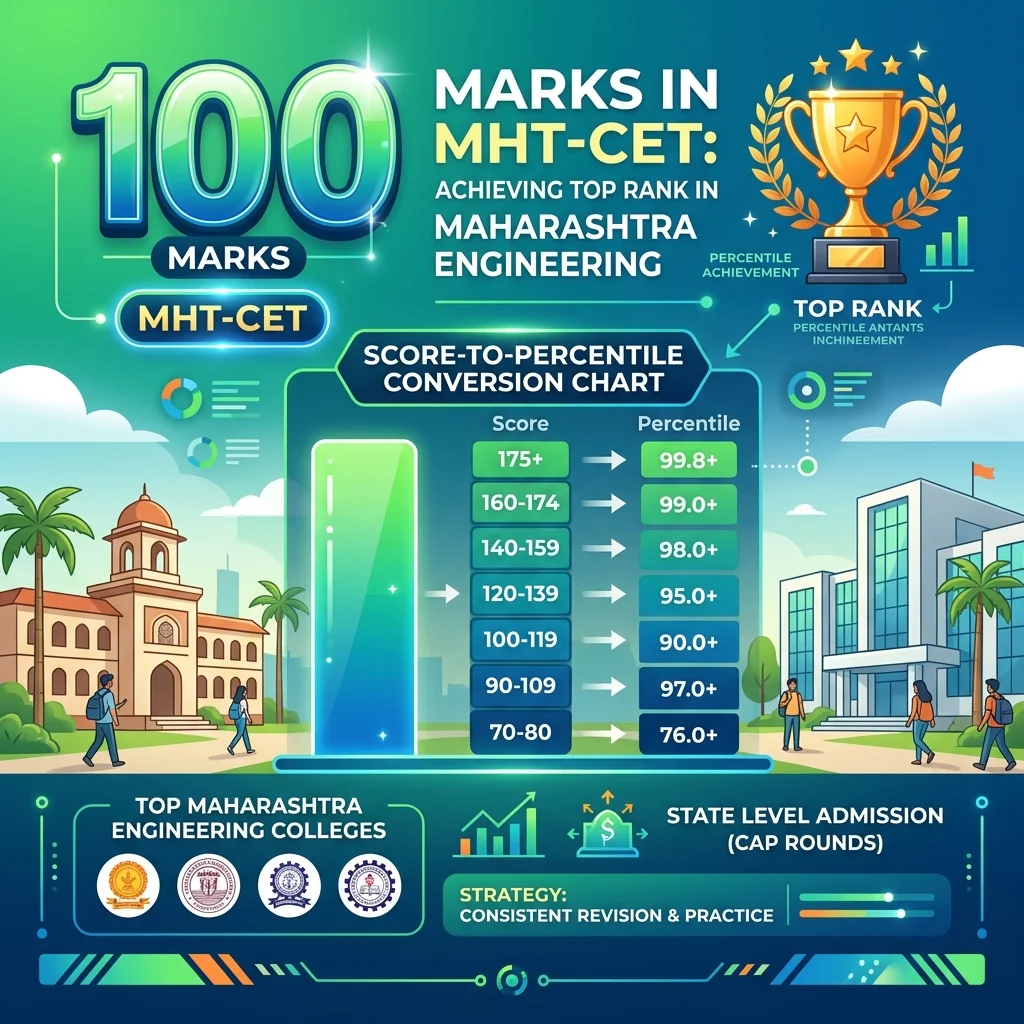
Scoring 100 marks in MHT CET 2026 is a meaningful milestone. It places you in a genuinely competitive bracket — above the median, well into the top 15% of all candidates — and it opens up a real range of quality colleges across Maharashtra. But knowing your score is only the starting point. What you actually need is a clear picture of what this score means in percentile terms, how it converts to a rank, and — most importantly — which colleges and branches you should be targeting during CAP Round.
This guide gives you that complete picture, grounded in actual 2024–25 CAP Round cutoff data rather than vague estimates.
Understanding Your Percentile at 100 Marks
MHT CET does not convert marks to percentile using a fixed formula. Because the exam runs across multiple days and sessions, each paper has a different difficulty level. The CET Cell uses a statistical normalization process to ensure students from different shifts are compared fairly. This means your actual percentile depends not just on your raw score of 100, but on how the rest of the candidates in your specific shift performed.
Here is what historical data from the last three cycles tells us about a 100-mark score:
| Your Exam Shift Type | Percentile for 100 Marks | Typical CRL Rank |
|---|---|---|
| Hard shift (fewer high scorers) | 90 – 93 percentile | ~18,000 – 30,000 |
| Moderate shift (standard difficulty) | 87 – 90 percentile | ~30,000 – 45,000 |
| Easy shift (many high scorers) | 84 – 87 percentile | ~45,000 – 60,000 |
Plan with 87–90 percentile as your central estimate — this is the moderate shift outcome that applies to most candidates. If your shift felt unusually difficult, expect to land closer to the 90–93 range, which would meaningfully improve your college options.
One thing worth noting about the 100-mark threshold specifically: because Mathematics in MHT CET carries 2 marks per question (while Physics and Chemistry carry 1 mark each), a student who is strong in Mathematics can reach 100 marks with significantly higher accuracy in that section. This matters because Mathematics performance also predicts academic readiness for engineering — colleges that track this know it.
Three Paths Available to You at 100 Marks
At the 87–93 percentile range, you're actually at an interesting crossroads in the Maharashtra engineering admission landscape. Three distinct paths are available, and which one makes sense for you depends on your career goals:
Path 1: Target Tier-2 Private Colleges for CS/IT
Colleges like MITAOE Alandi, JSPM RSCOE, NBN Sinhgad, Terna Nerul, and similar mid-tier private colleges have CS and IT closing cutoffs that fall in the 88–92 percentile range. At 90 percentile, you're right at the boundary — meaning you may get CS here in later CAP rounds when seats open up. Worth including in your preference list from Position 10 onwards after your realistic ENTC and IT choices.
Path 2: ENTC / Electrical at Better-Ranked Colleges
Electronics & Telecom and Electrical Engineering at colleges like PCCOE, Somaiya, or Thakur typically close at 87–92 percentile. At 100 marks, these branches at these colleges are genuinely within reach — and both branches have strong placement records and good career trajectories, especially for students interested in embedded systems, VLSI, or power sector jobs.
Path 3: Government-Aided Colleges for Any Branch
Government and government-aided colleges (Walchand Sangli, GCoE Chhatrapati Sambhajinagar, GCoE Karad, BVCOEP Pune) have significantly lower fees and well-maintained infrastructure. At 90 percentile, non-CS branches at these colleges are accessible. The fee advantage is substantial — often ₹30,000–₹50,000 per year vs ₹1+ lakh at private colleges for the same quality of education.
City-Wise College Options at 100 Marks (OPEN Category)
Based on 2024–25 CAP Round II and III closing cutoffs, these colleges and branches were accessible to OPEN category students at 85–90 percentile:
📍 Pune & PCMC
- MITAOE (MIT Academy of Engineering), Alandi — IT, ENTC, Mechanical Cutoff: 83–91%ile depending on branch
- JSPM Rajarshi Shahu College of Engineering — IT, Electrical, Civil Cutoff: 80–88%ile
- Indira College of Engineering & Management — CS (AI & ML), ENTC Cutoff: 81–87%ile
- Dr. DY Patil Institute of Technology, Pimpri — Mechanical, Civil Cutoff: 78–84%ile
- Smt. Kashibai Navale College of Engineering — IT, ENTC Cutoff: 83–90%ile
📍 Mumbai & MMR
- Vidyalankar Institute of Technology, Wadala — IT, ENTC Cutoff: 84–90%ile
- Terna Engineering College, Nerul — IT, Computer Engineering Cutoff: 82–88%ile
- Pillai College of Engineering, New Panvel — ENTC, Mechanical Cutoff: 80–87%ile
- Fr. Conceicao Rodrigues CoE, Bandra — Civil, Mechanical Cutoff: 77–86%ile
- Xavier Institute of Engineering, Mahim — Electrical, ENTC Cutoff: 79–85%ile
📍 Nagpur
- G.H. Raisoni College of Engineering — CS (AI & DS), IT Cutoff: 78–86%ile
- Priyadarshini College of Engineering — Mechanical, Civil, Electrical Cutoff: 72–83%ile
- YCCE (Yeshwantrao Chavan CoE) — ENTC, Mechanical Cutoff: 80–88%ile
📍 Rest of Maharashtra
- Walchand Institute of Technology, Solapur — Mechanical, Civil, ENTC Cutoff: 75–84%ile
- KIT's College of Engineering, Kolhapur — CS, IT, Mechanical Cutoff: 79–87%ile
- Shri Sant Gajanan Maharaj CoE, Shegaon — CS, IT Cutoff: 74–82%ile
- Government College of Engineering, Karad — Mechanical, Civil Cutoff: 76–83%ile
⚠️ These cutoffs are from 2024–25 and are for reference only. Actual 2026 cutoffs will shift based on exam difficulty, number of applicants, and seat availability. Use PredictCollege.in's predictor for current-year estimates closer to your CAP Round dates.
The Mathematics Advantage — Why 100 Marks Is Different
Something that most percentile guides don't mention: the MHT CET scoring structure gives Mathematics double weightage (2 marks per question) compared to Physics and Chemistry (1 mark per question). This means:
- A student who scored 40 in Maths + 30 in Physics + 30 in Chemistry = 100 total marks
- A student who scored 20 in Maths + 40 in Physics + 40 in Chemistry = also 100 total marks
Both have the same raw score of 100, but their academic profiles are very different. For engineering admissions, strong Mathematics performance is a better predictor of readiness for first-year engineering subjects (Engineering Mathematics, Physics, and numerically-heavy core subjects). Some colleges and scholarship programs factor in subject-wise performance during tie-breaking or merit scholarships.
If your 100 marks includes a strong Maths component (50+ out of the 100 possible Maths marks), that's a solid academic foundation going into any engineering branch.
CAP Round Strategy: Making Your 100 Marks Count
Getting a good college with 100 marks is more about strategy than luck. Here's a structured approach:
- Set up three tiers in your preference list. Tier 1 (Positions 1–15): Reach choices at 91–94 percentile cutoff colleges. Tier 2 (Positions 16–60): Match choices at 85–90 percentile cutoff. Tier 3 (Positions 61–100+): Safety choices at 78–84 percentile cutoff. Never skip Tier 3 — it protects you if both Round 1 and Round 2 don't work out as planned.
- Shortlist branches honestly. If you genuinely don't have a strong preference, prioritize IT, ENTC, or AI & Data Science over Mechanical or Civil in current market conditions. These branches have broader job options at the entry level.
- Check TFWS eligibility. If your family income is under ₹8 lakh per year, apply for TFWS seats simultaneously. At 90 percentile, you're competitive for TFWS CS seats at some mid-tier colleges, which can save ₹3–5 lakh in fees over four years.
- Don't obsess over Round 1. The best seats often come in Round 2 and Round 3, as students who received better allotments in Round 1 vacate their seats. Students who choose "Accept & Upgrade" after a mediocre Round 1 allotment often end up with significantly better final outcomes.
- Research placement data, not just college names. Visit the NIRF ranking portal and check the college's graduate outcomes. Many mid-tier colleges with 85–90 percentile cutoffs have genuinely strong placement records in specific branches.
✅ Specific Tip for 100-Mark Students: At this exact score range, the difference between a 88 and a 92 percentile outcome (based on your shift) can change your college options significantly. Before making any assumptions, wait for the official result and check your exact percentile before finalizing your choice list. Plan for both scenarios using the predictor tool.
Frequently Asked Questions
Can I get admission to a NAAC A-graded college with 100 marks?
Yes. Several NAAC A and A+ graded engineering colleges in Maharashtra have branch-specific cutoffs in the 82–90 percentile range for non-CS branches. NAAC A-graded colleges with closing cutoffs in this range include institutions in Pune, Mumbai, Nagpur, and Chhatrapati Sambhajinagar. Use our predictor and filter by NAAC grade if that's your priority.
Is 100 marks enough for Computer Engineering (not CS)?
Computer Engineering (CE) is a separate branch from Computer Science (CS) but has similar demand and often similar cutoffs. In some colleges, CE cutoffs run 2–4 percentile points below CS. At 87–90 percentile, CE is more accessible than CS at mid-tier colleges. It's worth including CE as a preference alongside IT and CS in your choice list.
What's the fee difference between government and private colleges for this percentile range?
Government and government-aided colleges charge annual fees of ₹15,000–₹50,000 per year for most branches. Private unaided colleges at the same cutoff range typically charge ₹90,000–₹1,50,000 per year. Over four years, this is a difference of ₹2–4 lakh. If you can get into a government-aided college in a branch you like, the fee advantage is very real and worth prioritizing over a private college of similar rank.
Should I choose a better branch in a weaker college or a weaker branch in a better college?
This is one of the most common dilemmas at the 85–90 percentile range. The answer depends on your career goals — but for students who want software/IT jobs, a high-demand branch (CS/IT/ENTC) at a decent mid-tier college typically produces better placement outcomes than a low-demand branch (Civil/Mech) at a slightly better-ranked college. Read our detailed guide on Branch vs College for a full breakdown.
A score of 100 marks in MHT CET 2026 puts you in a bracket where real, quality options exist — you just need to find and access them strategically. Don't let the absence of a top-tier college name discourage you. Many of India's most successful engineers came from mid-tier colleges where they received excellent practical training, built strong networks, and developed the skills that matter in actual jobs.
Use the PredictCollege.in predictor with your actual percentile and category to generate a personalised list of colleges within your range — sorted by Safe, Moderate, and Reach categories. That list is your starting point for building a strong CAP Round choice form.