120 Marks in MHT CET 2026 — Percentile, Rank & Top College Guide
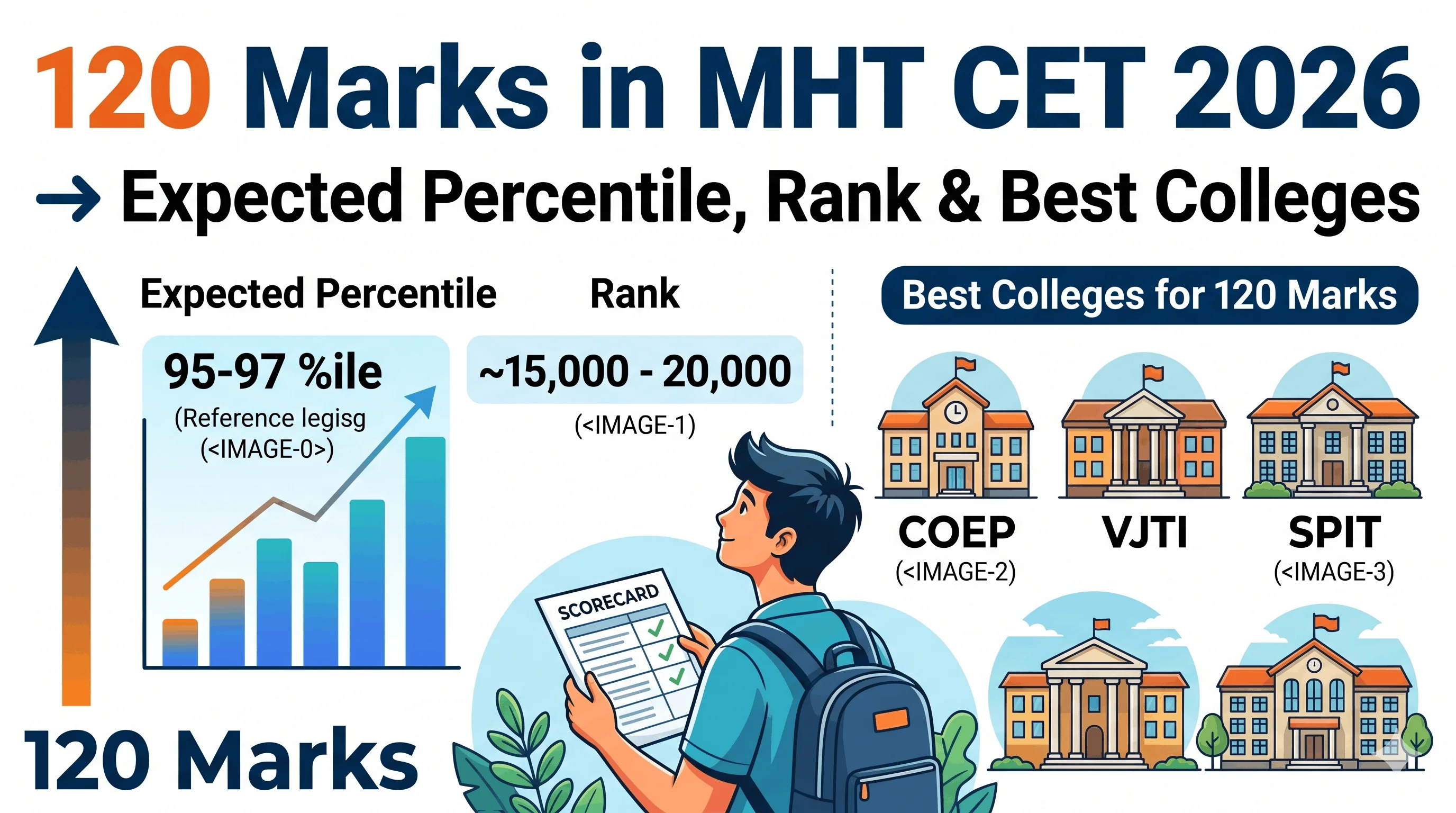
A score of 120 marks in MHT CET 2026 lands you in an elite bracket. You're in the top 3–5% of approximately 6 lakh candidates — a position that gives you access to some of Maharashtra's best private and government engineering colleges. But this is also the score range where strategic mistakes cost the most, because the gap between what you can access and what you're reaching for unrealistically is wide enough to cause real disappointment if you're not informed.
This guide gives you a precise, data-backed picture of your percentile, rank, and college options — along with a CAP Round strategy specifically calibrated for the 95–98 percentile range.
Your Percentile at 120 Marks — The Precise Breakdown
MHT CET conducts the exam across multiple sessions with varying difficulty levels. The CET Cell applies normalization so that students across all shifts are compared on an equal footing. This means your final percentile isn't simply based on how many questions you got right — it's based on how your score compares to everyone else who took the exam, adjusted for shift difficulty.
Here's what 120 marks translates to across different shift scenarios, based on 2023–2025 historical patterns:
| Shift Type | Percentile Range | Approx. CRL Rank | Implication |
|---|---|---|---|
| Hard shift | 97 – 98.5 percentile | ~9,000 – 18,000 | Strong access to top private colleges for CS/IT |
| Moderate shift | 95.5 – 97 percentile | ~18,000 – 27,000 | Tier-1.5 colleges for CS; Tier-1 for ENTC/Mech |
| Easy shift | 94 – 95.5 percentile | ~27,000 – 36,000 | Strong mid-tier options; COEP non-CS branches viable |
Use 95.5–97 percentile as your planning baseline — the moderate shift outcome applies to the majority of candidates. That said, always wait for the official result before finalising your choice list. The difference between 95 and 97.5 percentile is significant at this score range in terms of which specific colleges become realistic.
One important nuance for 120-mark students: because Mathematics carries double weightage in MHT CET (2 marks per question vs 1 mark for Physics and Chemistry), a student who scored 60/100 in Maths and 30/100 combined in PCh has a very different academic profile from someone who spread their marks more evenly. Colleges that scrutinise subject-wise performance for merit scholarships and internal rankings will see this difference.
What's Genuinely Within Reach — College List by Tier
This is the section most guides get wrong. At 95–97 percentile, you have access to excellent colleges — but not the absolute top 5 for every branch. Here's an honest, tier-based breakdown using 2024–25 CAP Round data:
⚠️ Cutoffs shown are directional estimates from 2024–25 CAP Round data. Actual 2026 cutoffs will vary. Always verify with PredictCollege.in's predictor once your official percentile is declared.
Three Strategic Opportunities Unique to This Score Range
COEP Non-CS Branches — Underrated at This Percentile
COEP's Computer Science and IT branches require 98.5+ percentile and are out of reach for most 120-mark students. However, COEP's Mechanical, Electrical, Civil, and Metallurgy branches have closing cutoffs in the 95–97 percentile range — well within reach. COEP as an institution carries enormous brand value for placements, GATE preparation, and higher studies abroad. A COEP Mechanical degree opens doors that a private college CS degree sometimes cannot. If you're interested in core engineering, this is a compelling option.
TFWS at Tier-1 Private Colleges — Save ₹4+ Lakh
If your family income is under ₹8 lakh per year, TFWS (Tuition Fee Waiver Scheme) seats at colleges like VIT Pune, Somaiya, and SPIT are genuinely within reach at 95–97 percentile. TFWS cutoffs at these colleges run 1–3 percentile points above regular OPEN cutoffs, which you can meet. The saving over four years — ₹3.5 to ₹5 lakh in tuition fees — is very real. Read the full TFWS guide before your CAP registration.
Emerging Branches — Better Access, Strong Career Paths
Branches like CS (Artificial Intelligence & Machine Learning), CS (Data Science), and VLSI Design have lower cutoffs than traditional CS at the same college because they are newer and students are less familiar with them. At 96 percentile, you can often access these branches at colleges where traditional CS requires 98+ percentile. The curriculum is highly relevant to current industry needs — these are not inferior alternatives, they are well-funded newer programs with strong placement outcomes.
City-Wise Best Bets at 120 Marks
Pune
Pune offers the densest concentration of quality engineering colleges accessible at 95–97 percentile. VIT Pune for CS/IT/ENTC, COEP for non-CS branches, PVPIT for IT and ENTC, and Symbiosis Institute of Technology for CS and IT are all realistic targets. For students open to lower fees, government-aided options in nearby Sangli (Walchand) and Solapur (WIT) also fall within range.
Mumbai
Mumbai's standout options at this percentile include SPIT Andheri (IT and ENTC), Somaiya Sion (CS and IT), Thadomal Shahani (CS), and VJTI for non-CS branches. Mumbai colleges carry strong placement networks with city-based MNCs and startups. SPIT in particular has consistently placed students in top product companies. Note that Mumbai colleges have a Home University vs Other University seat split — your cutoff may differ depending on whether your HSC was from the Mumbai university zone.
Nagpur & Rest of Maharashtra
Students flexible about location can access significantly better branch-college combinations outside Mumbai-Pune. YCCE Nagpur, RCOEM Nagpur, and GCOE Amravati all have CS and IT closing cutoffs in the 90–95 percentile range — giving you first-choice access to these branches at colleges with genuinely good placement records in the Vidarbha region. Government engineering colleges in Chhatrapati Sambhajinagar and Nashik similarly offer CS access at lower percentiles than Pune/Mumbai equivalents.
CAP Round Strategy for 95–97 Percentile Students
At this score range, your primary risk is not getting a bad college — it's getting a decent college when an excellent one was available through smarter choice filling. Here's how to avoid that:
1. Understand the Seat Release Pattern Between Rounds
In Round 1, the highest-merit students claim their best choices. Many of them will receive allotments at colleges well above their safe choices and freeze immediately. This releases their "match" and "safety" choices for Round 2. As a 95–97 percentile student, you benefit enormously from this: colleges that were out of reach in Round 1 can become accessible in Round 2 because the seats released are from students who moved up. Always participate in all three rounds with "Accept & Upgrade" if your first allotment isn't what you wanted.
2. Build a 90-Choice Form — Not Just 20
A common mistake at this percentile range is filling only 20–30 choices because students assume their high percentile guarantees a good outcome with fewer choices. It doesn't. The difference between Choice 15 and Choice 45 on your preference form can be the difference between VIT IT and MITAOE IT. More choices give the algorithm more ways to place you at your highest available preference.
3. Know When CS is Realistic vs When to Target ENTC
CS at the top 10 colleges in Maharashtra requires 97.5+ percentile. At 95–96 percentile, CS at mid-tier colleges and ENTC/IT at better colleges are often smarter choices. ENTC at SPIT, VIT, or Somaiya has strong placement records and is an excellent branch for students interested in embedded systems, VLSI, or telecommunications — all of which have growing demand in the industry.
4. Do Not Ignore Government-Aided Colleges
Students at this percentile often overlook government-aided colleges because the brand perception feels less exciting than prominent private colleges. This is a financial mistake. Government-aided colleges like Walchand Sangli charge ₹25,000–₹50,000 per year in tuition. A private college at the same cutoff range charges ₹1–1.5 lakh per year. Over four years, that's a ₹2–4 lakh difference for a degree that is academically comparable and recognised by the same employers.
✅ Pro Tip: Before submitting your final choice list, verify each college's NAAC accreditation status on the official NAAC website (naac.gov.in). Prefer colleges with NAAC A or A+ grades. At the 95–97 percentile range, several NAAC A+ colleges are accessible and the accreditation grade is a reliable proxy for academic quality and infrastructure.
Marks vs Percentile Reference Table (2026)
| Marks Scored | Expected Percentile | Approx. CRL Rank | College Tier Accessible |
|---|---|---|---|
| 150+ | 99.3 – 99.8%ile | ~1,200 – 4,200 | IIT JEE-adjacent, COEP/VJTI CS |
| 135 – 149 | 98 – 99.3%ile | ~4,200 – 12,000 | PCCOE CS, PICT CS, VJTI select |
| 120 – 134 | 95 – 98%ile | ~12,000 – 30,000 | VIT, SPIT, Somaiya, COEP non-CS |
| 105 – 119 | 92 – 95%ile | ~30,000 – 48,000 | Tier-1.5 private, Walchand, YCCE |
| 90 – 104 | 85 – 92%ile | ~48,000 – 90,000 | Mid-tier private, GCoE aided |
Frequently Asked Questions
Can I get a government college with 120 marks?
Yes — but not for every branch. COEP Pune and VJTI Mumbai require 98–99+ percentile for Computer Science. However, non-CS branches at both colleges (Mechanical, Civil, Electrical, ENTC) close in the 95–97 percentile range, which is accessible at 120 marks depending on your shift. Government-aided colleges like Walchand Sangli and GCoE Chhatrapati Sambhajinagar are more accessible across all branches at this score.
What is the expected rank for 120 marks in MHT CET 2026?
Based on historical normalization patterns, 120 marks typically places you in the 95–97 percentile range, corresponding to a CRL rank of approximately 18,000–30,000 on a moderate-difficulty exam. On a hard shift, your rank could be as good as 9,000–18,000. On an easy shift, expect 27,000–36,000. Your final rank is published officially by the State CET Cell after results are declared.
Is 120 marks enough for Computer Science in a top college?
It depends on which college and which shift you appeared in. CS at PCCOE, PICT, and COEP requires 97.5–99%ile — which is only achievable from 120 marks if you had a genuinely hard shift outcome pushing you to 97.5+. CS at VIT Pune, Somaiya, SPIT, and Thadomal Shahani is realistic at 95–97 percentile, which most 120-mark students can achieve. CS at mid-tier colleges is comfortably within range for everyone at this score.
Should I choose COEP Mechanical over VIT Computer Science?
This is one of the most nuanced decisions students in this range face. COEP's institutional brand, research environment, and government-aided fee structure are genuinely strong arguments for choosing it even in Mechanical. VIT's CS placement outcomes and software job access are strong arguments for the other side. The right answer depends on your career direction — core engineering and higher studies favour COEP; software and immediate placements favour VIT CS. Read our detailed Branch vs College guide for a fuller framework.
How does Home University vs Other University affect my options?
Each college in Maharashtra has a percentage of seats reserved for students whose HSC board falls in the same university zone (Home University) and the remaining for students from other zones. For Mumbai colleges, if your HSC was from a Pune or Nagpur board, you compete in the "Other University" pool, which typically has slightly higher cutoffs. This can affect 1–3 percentile points of eligibility. Check each college's seat matrix on the DTE portal to see how many Home vs Other University seats are available.
Scoring 120 marks in MHT CET 2026 places you in a genuinely strong position. The students who convert this score into the best possible outcome are those who understand exactly which colleges are realistically within reach, fill a comprehensive and well-researched choice list, and use the three-round CAP process intelligently rather than settling too early.
Use the PredictCollege.in predictor with your official percentile and category as soon as results are out. Generate your full list of Safe, Moderate, and Reach colleges as the foundation for your CAP choice form.