Engineering Branch Selection Guide — Which Branch is Best for YOU?
Published: April 24, 2026 · 14 min read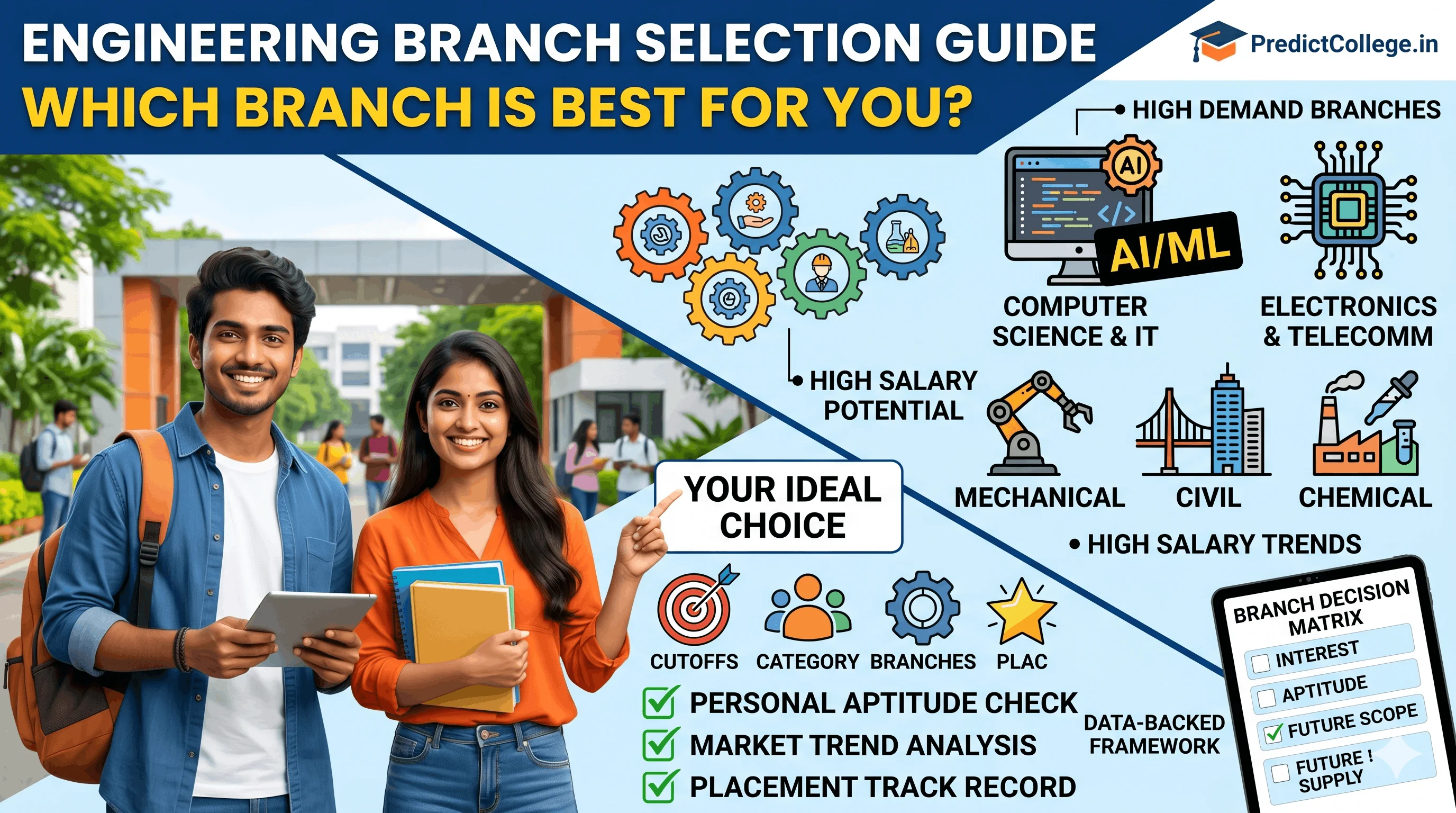
Every year, thousands of MHT CET students land on the option form filling page and freeze. Not because of their percentile — but because they genuinely don't know which engineering branch to choose. Computer Science is "everyone's first choice," but is it actually the right choice for you?
This guide cuts through the noise. We break down every major engineering branch available in Maharashtra — what you study, what kind of work it leads to, who it's best suited for, and what the job market looks like in 2026. By the end of this article, you'll have a clear framework to make this decision confidently.
Key Takeaways
- There is no single "best" branch — the right branch depends on your interests, strengths, and career goals.
- CS/IT has the highest demand right now, but it's also the most competitive and saturation is increasing.
- Mechanical, Civil, and Electrical are evergreen branches with strong placement in core industries.
- Emerging branches like AI/ML, Data Science, and Cybersecurity are gaining traction rapidly in Maharashtra colleges.
- College quality often matters more than branch — a good college with Mechanical can outperform a poor college with CS.
The Real Question: What Do YOU Want?
Before picking a branch, answer these three questions honestly:
- What subjects do you enjoy? — Mathematics, Physics, Biology, Computing, Drawing, Economics?
- What kind of work sounds interesting? — Building software, designing machines, managing construction, working with circuits, analysing data?
- What career outcome are you targeting? — Software job, government job, higher studies (GATE/MBA), entrepreneurship, or family business?
Your answers to these questions are more valuable than any ranking of "top branches." Let them guide you through the options below.
Computer Science Engineering (CSE)
Computer Science Engineering (CSE)
CSE covers programming, algorithms, data structures, operating systems, databases, software engineering, computer networks, and increasingly — AI/ML, cloud computing, and cybersecurity. It's the broadest and most versatile branch in engineering today.
Best for: Students who enjoy logical problem solving, coding, mathematics, and want to work in the software industry. If you are comfortable sitting at a computer and building or debugging systems for hours, CSE is a natural fit.
Typical careers: Software Developer, Data Engineer, Full Stack Developer, DevOps Engineer, Product Manager, AI Engineer, Startup Founder.
Be aware: CSE seats are highly sought after, so cutoffs are the highest of any branch. Additionally, the market is competitive — the degree alone isn't enough. You must build real projects and skills beyond the syllabus to stand out in campus placements.
Information Technology (IT)
Information Technology (IT)
IT is very similar to CSE but with slightly more emphasis on networking, systems, web technologies, and enterprise applications rather than core computer science theory. In terms of job opportunities and salary, IT and CSE are practically equivalent at the fresher level.
Best for: Students who prefer IT applications, networks, cybersecurity, and enterprise software over core programming theory. If you couldn't get CSE in your preferred college, IT at the same college is an excellent alternative.
Typical careers: Systems Engineer, Network Admin, IT Consultant, Web Developer, Cloud Engineer, Cybersecurity Analyst.
Electronics and Telecommunication (ENTC)
Electronics and Telecommunication Engineering (ENTC)
ENTC sits at the intersection of hardware and software. You'll study analog and digital electronics, microprocessors, communication systems, embedded systems, VLSI design, and signal processing. It's the branch that powers everything from smartphones to satellites.
Best for: Students fascinated by circuits, electronics hardware, IoT devices, and communication systems. If you loved practical electronics in your school labs and want to work in hardware + embedded systems, ENTC is the perfect pick.
Typical careers: Embedded Systems Engineer, VLSI Design Engineer, Telecom Engineer, IoT Developer, Signal Processing Engineer, Hardware Design Engineer.
In 2026: ENTC graduates are increasingly valuable in semiconductor companies, EV electronics, and IoT. The global chip shortage of the early 2020s triggered massive investment in semiconductor manufacturing — ENTC students are well-positioned to benefit.
Mechanical Engineering
Mechanical Engineering
Mechanical is one of the oldest and most fundamental engineering branches. It covers thermodynamics, fluid mechanics, machine design, manufacturing processes, CAD/CAM, and materials science. Almost every industry — from automobiles to aerospace to FMCG — employs mechanical engineers.
Best for: Students who love physics, enjoy working with machines and physical systems, and are interested in manufacturing, automotive, energy, or aerospace industries. If you want a government job through MPSC or UPSC (ESE), Mechanical is among the best choices.
Typical careers: Design Engineer, Production Engineer, Quality Engineer, HVAC Engineer, Automotive Engineer, EV Powertrain Engineer, Government (PWD/Railways/DRDO).
Reality check: Core mechanical placements may feel slower than IT during campus season — but students who target the right companies and pursue GATE for PSU jobs find Mechanical to be extremely rewarding in the long run.
Civil Engineering
Civil Engineering
Civil engineering deals with the design, construction, and maintenance of infrastructure — roads, bridges, buildings, dams, water supply systems, and urban planning. With India investing heavily in infrastructure through initiatives like PM Gati Shakti and Smart Cities Mission, civil engineers are in strong demand through 2030.
Best for: Students interested in construction, urban planning, government projects, and real estate. Civil engineering is also the top choice if your family has a construction or contracting business.
Typical careers: Site Engineer, Structural Engineer, Urban Planner, Government (MSRDC/PWD/NHAI), Real Estate Developer, Construction Project Manager.
Bonus: Civil engineering has one of the most accessible paths to government jobs in Maharashtra — MPSC Engineering Services exams specifically recruit civil engineers in large numbers.
Electrical Engineering (EE)
Electrical Engineering (EE)
Electrical engineering focuses on power systems, electrical machines, control systems, power electronics, and renewable energy. The energy transition — solar, wind, EVs, and smart grids — is creating a surge in demand for electrical engineers globally.
Best for: Students interested in power systems, energy, and electrical infrastructure. Also an excellent choice for those targeting GATE (Electrical has one of the largest PSU recruitment pools) or government electricity board jobs (MSEB/MAHADISCOM).
Typical careers: Power Systems Engineer, Electrical Design Engineer, Control Systems Engineer, EV Battery Engineer, Government (MSEDCL/Power Grid/NTPC).
Emerging Branches Worth Considering in 2026
Maharashtra universities and colleges are now offering several newer, specialized branches that are gaining significant traction. If you see these options in your college list, here's what you need to know:
| Branch | Focus Area | Best For | Job Market (2026) |
|---|---|---|---|
| AI & Machine Learning | Deep learning, NLP, computer vision, AI systems | Students passionate about AI research and applied ML | Very High — fastest growing segment |
| Data Science & Engineering | Analytics, big data, statistics, visualization | Students strong in maths and statistics | High — data roles across all industries |
| Cyber Security | Network security, ethical hacking, cryptography | Students interested in security and hacking | High — critical shortage of professionals |
| Internet of Things (IoT) | Connected devices, sensors, embedded + cloud | Students at electronics + software intersection | Moderate–High — smart manufacturing and cities |
| Robotics & Automation | Industrial robots, control, mechatronics | Students who love both mechanical and electronics | Moderate — rising with EV and Industry 4.0 |
The College vs Branch Dilemma
One of the most debated questions among MHT CET students is: Should I take a better college with a less preferred branch, or a preferred branch in a lower-ranked college?
The answer almost always leans toward better college, slightly less preferred branch — with one important exception.
Here's a practical framework:
- If the branch difference is small (e.g., IT vs CS, or ENTC vs CS at a top autonomous college) — always take the better college. The infrastructure, faculty, and placement network matter far more than the label on your degree.
- If the branch difference is fundamental (e.g., Civil vs CS) — consider your interest and career goals carefully. Taking Civil at a tier-1 college when your goal is a software job makes less sense than taking CS at a solid tier-2 college.
- Never take a branch you have zero interest in just for brand name. Four years is a long time to be miserable, and it shows in your performance and placements.
A Quick Self-Assessment: Which Branch Fits You?
| If you… | Consider This Branch |
|---|---|
| Love coding and want a software career | CSE / IT / AI&ML |
| Enjoy electronics and circuits | ENTC / Electrical |
| Are a physics/maths person who loves machines | Mechanical |
| Want government jobs or have a construction business | Civil / Electrical / Mechanical |
| Are fascinated by data and statistics | CSE / Data Science |
| Want to work in renewable energy or EVs | Electrical / Mechanical |
| Are interested in defence, aerospace, or DRDO | Mechanical / Electrical / ENTC |
| Want to pursue GATE for M.Tech or PSU | Any branch with GATE potential — CS, ME, EE, CE are best |
| Are interested in security and ethical hacking | CS / IT / Cyber Security |
Conclusion
Choosing your engineering branch is not a gamble if you approach it with self-awareness and information. The "best" branch is the one that aligns your natural interests with a career path that genuinely excites you — not the one with the highest cutoff or the one your relatives recommend at family functions.
CSE is a great choice if you love programming. Mechanical is a great choice if machines fascinate you. Civil is a great choice if infrastructure and construction are your world. All of these branches have produced highly successful professionals in Maharashtra and beyond.
Take time to reflect on your strengths, research the job market, and use data to make smart college-branch combinations during option form filling. Use our free MHT CET College Predictor to identify which college-branch pairs are within your reach and start building your shortlist today.
Frequently Asked Questions
Is Computer Science still the best branch for placements in 2026?
CSE continues to have the highest volume of campus placements in terms of IT sector jobs. However, competition is also the highest. Students from Mechanical, Civil, and Electrical branches targeting core industries or government jobs often have equally strong outcomes. The "best" branch for placement depends entirely on which industry and role you're targeting.
Is Mechanical Engineering still relevant in 2026?
Absolutely. The EV revolution, aerospace expansion, defence manufacturing, and smart manufacturing (Industry 4.0) are creating strong demand for mechanical engineers in 2026. Mechanical engineers who upskill in CAD/CAM, simulation software, or EV powertrain systems are particularly sought after. GATE + PSU route also remains one of the strongest career paths for Mechanical graduates.
What if I don't get my preferred branch in my preferred college?
Prioritize college quality over branch if the branch difference is not fundamental to your career goals. An autonomous, well-placed tier-1 college with IT will almost always outperform a tier-3 college with CSE. Also consider participating in all CAP rounds and the Institute Level round — seats do open up in later rounds.
Are newer branches like AI/ML and Data Science worth choosing?
They can be excellent choices if the college offering them has strong faculty, labs, and placement support for those specific branches. However, be cautious — many colleges started these branches recently without adequate resources. In such cases, a strong traditional CS or IT department often prepares you better for AI/ML roles than a poorly resourced specialized branch.
Should I take Civil Engineering if my family has a construction business?
Yes, Civil Engineering is one of the strongest choices in this context. You gain formal technical knowledge directly applicable to your family business, plus access to government contracts (which require licensed civil engineers), and the option to pursue MPSC Engineering Services for a government career backup.
Is ENTC (Electronics) better than Electrical Engineering?
They are different branches with different focuses. ENTC leans toward consumer electronics, embedded systems, VLSI, and telecommunications. Electrical leans toward power systems, energy, motors, and smart grids. Neither is universally "better" — choose based on whether you're more interested in electronics hardware or energy/power systems. For GATE and PSU recruitment, Electrical has a larger pool of openings.