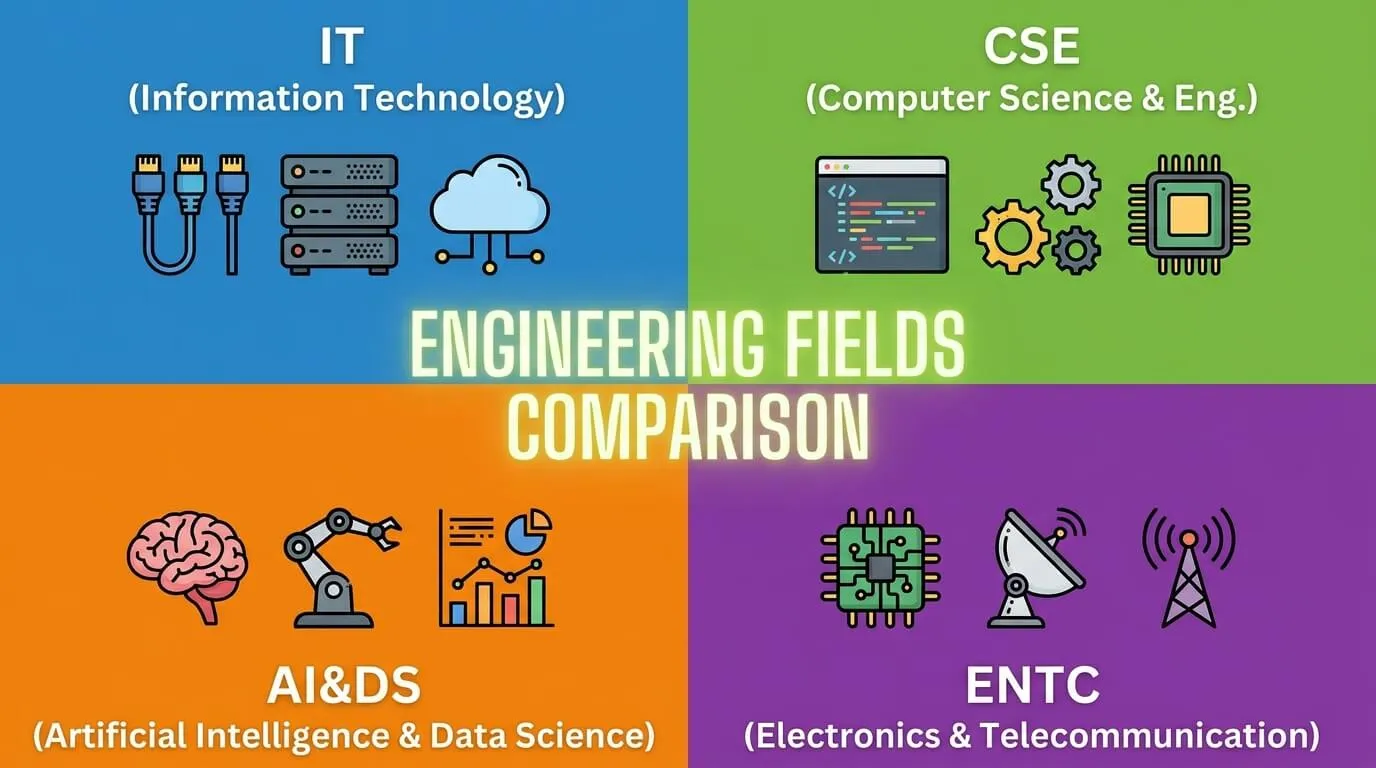
🎓 Engineering Admission Guide 2026
CSE offers the widest software career options and highest packages, but demands the highest MHT CET percentile. IT is very similar to CSE with slightly lower cutoffs and comparable outcomes. AI&DS is the smartest choice if you can't get CSE at a good college — same industry demand, lower cutoff. ENTC is the most underrated branch in 2026 — dual eligibility for both hardware and software, and massive demand from India's semiconductor boom, 5G rollout, and ISRO expansion.
Every year, lakhs of engineering aspirants across India face the same decision: CSE, IT, AI&DS, or ENTC? And every year, most of them make the choice based on one of three things — what their parents say, what their friends are choosing, or which branch sounds the most "engineering-ish." None of those are good reasons.
The honest truth is that all four branches lead to careers in technology. But they have meaningfully different syllabuses, different strengths in different industries, different MHT CET cutoffs, and different career ceilings. Understanding these differences — not the surface-level "CSE is about software, ENTC is about hardware" version, but the actual, practical 2026 version — is how you make the right choice.
Every engineering branch has a fundamental DNA — a blend of coding, mathematics, hardware, systems thinking, and applied practice. Understanding this DNA helps you figure out which branch genuinely matches how your mind works and what you enjoy doing.
| Subject Category | CSE | IT | AI&DS | ENTC |
|---|---|---|---|---|
| Core Programming | C, C++, Java, Python — deep | Python, Java, Web (deep) | Python (deep), R | C, embedded C (moderate) |
| Mathematics | Discrete math, automata theory, algorithm analysis | Discrete math, probability | Statistics, probability, linear algebra (heaviest of 4) | Signals, transforms (Fourier, Laplace) |
| Systems Knowledge | OS, computer architecture, compilers, networks | Networks, cloud, information systems | ML pipelines, data engineering, cloud AI | Microprocessors, VLSI, embedded systems |
| Industry-Specific Subjects | Software engineering, cryptography, distributed systems | Cybersecurity, web tech, ERP/enterprise systems | Deep learning, NLP, computer vision, big data | Antenna theory, optical fibre, satellite comms, VLSI design |
| Unique Advantage | Broadest software career preparation | Most practical, industry-ready from Day 1 | Most directly aligned with AI/data science jobs | Only branch with hardware + software dual capability |
Here is the question most students never explicitly ask: if CSE requires 4–6 percentile points more than IT at the same college, and IT requires 3–5 more than AI&DS — is the extra percentile cost actually worth it in career outcome?
The key insight that most guides miss: the cutoff gap at the same college is smaller than students think, but the gap between college tiers is massive.
Consider this real scenario: You have 87 percentile. CSE at a mid-tier non-autonomous college requires 86%. AI&DS at a NAAC A autonomous college with better placements requires 84%. Choosing CSE at the weaker college over AI&DS at the stronger one is a mistake — because college quality affects your career far more than the branch name at the same quality tier.
| Factor | CSE | IT | AI&DS | ENTC |
|---|---|---|---|---|
| Average package (Tier-2 college) | ₹6–10 LPA | ₹5–8 LPA | ₹5–9 LPA | ₹4–7 LPA (core) ₹5–8 LPA (software) |
| Top recruiter types | Product cos, FAANG, startups, service IT | Service IT, startups, cloud cos, consulting | AI startups, data teams, product cos, analytics | Semiconductor, telecom, embedded, defence, IT |
| Placement % (good autonomous college) | 65–80% | 60–75% | 60–75% | 55–70% |
| Software job eligibility | 100% | 100% | 95% | 90% (most IT companies include ENTC) |
| Core hardware job eligibility | Very limited | Very limited | Very limited | ✓ Full eligibility |
| PSU / Govt exam eligibility | GATE CS, limited PSU | GATE CS, limited PSU | Limited GATE options | GATE EC + ISRO/DRDO/BEL/ECIL/BHEL |
| 2026 demand growth | High | Stable-High | Very High (fastest growing) | Very High (semiconductor boom) |
For years, ENTC was the branch students "settled for" when they couldn't get CSE or IT. That narrative is changing rapidly in 2026 — and students who pick ENTC strategically are going to benefit enormously in the next 5 years.
| Parameter | CSE | IT | AI&DS | ENTC |
|---|---|---|---|---|
| MHT CET cutoff (same college) | Highest | 2–4% lower | 3–6% lower | 6–10% lower |
| Syllabus complexity | High (theory-heavy) | Moderate | High (math-heavy) | High (hardware-heavy) |
| Coding requirement | Very high | Very high | High (Python/ML) | Moderate |
| Software job access | ✓ Best | ✓ Very good | ✓ Very good | ✓ Good |
| Hardware / core job access | Very limited | Very limited | Very limited | ✓ Only branch with this |
| AI/ML career readiness | Good (with electives) | Moderate | ✓ Best | Limited |
| PSU / GATE options | GATE CS only | GATE CS only | Limited | GATE EC + many PSUs |
| 2026 industry demand | High | Stable | Very High (AI boom) | Very High (semiconductor + 5G) |
| Best for students who love | Algorithms, systems, OS, building software products | Web, databases, cloud, enterprise apps | Math, data, statistics, AI models | Circuits, signals, devices, dual careers |
You genuinely enjoy programming, solve DSA problems for fun, and your goal is to work at a product company or startup. You want maximum software career flexibility.
→ Choose CSEYou want to build real applications — websites, apps, databases, cloud systems. You prefer applying technology over studying its theory. You are industry-ready by Year 2.
→ Choose ITYou enjoy statistics, patterns, and making sense of data. You are fascinated by how AI models work. You are comfortable with Python, probability, and linear algebra.
→ Choose AI&DSYou love electronics, circuits, and how devices work at a physical level — but you also want software career options as a backup. You are interested in VLSI, IoT, embedded systems, or telecom.
→ Choose ENTCYou're 17 and you genuinely don't know what you want to do. You want maximum flexibility. You don't hate any subject particularly, and you want to keep options open.
→ ENTC or IT (dual eligibility buys you time)Answer these 5 questions honestly. Your most frequent answer reveals which branch genuinely fits your profile. This is not a quiz — it is a structured reflection exercise.
A CSE seat at a non-autonomous, low-placement college consistently underperforms AI&DS at a NAAC A autonomous college. Branch name on the degree matters far less than the quality of education, faculty, and placement network you are enrolled in. Compare college quality, not just branch names.
✓ Fix: Use the College Predictor to compare both options side by sideThis is 2019 thinking. All major IT companies include ENTC in eligible branches. An ENTC student who learns DSA and competitive programming has the same IT placement opportunities as an IT student — plus semiconductor, telecom, defence, and PSU options that IT students do not have. Dual eligibility is a career advantage, not a limitation.
✓ Fix: Check actual JD eligibility lists on Infosys, TCS, Wipro careers pagesAI&DS has the heaviest mathematics content of these four branches — probability, statistics, linear algebra, calculus for ML, and optimisation theory. Students who dislike or struggle with mathematics find AI&DS genuinely hard, even though the Python coding is straightforward. Be honest with yourself about your relationship with maths before choosing this branch.
✓ Fix: Take the PredictCollege Career Test to assess your aptitude alignmentAt most Indian colleges, CSE and IT share 60–70% of their curriculum. The differences are in depth — CSE goes deeper into theoretical computer science and algorithms; IT goes broader into enterprise applications and networks. For most industry roles below the senior level, hiring managers treat CSE and IT as equivalent. Don't sacrifice a better college or a TFWS seat to get CSE over IT.
✓ Fix: Check actual company JDs — most say "CSE/IT/equivalent branches"CSE (Computer Science Engineering) focuses on the theoretical foundations of computing — algorithms, operating systems, compilers, computer architecture, and systems programming. IT (Information Technology) focuses on applying technology to enterprise needs — web development, databases, cloud systems, networking, and information systems. In practice, they share 60–70% of their syllabus, and most employers treat them as equivalent. CSE typically has slightly higher MHT CET cutoffs and marginally better average packages at top product companies.
Yes — AI&DS is one of the best branch choices in 2026. NASSCOM estimates India needs 11.5 million AI professionals. AI&DS has lower cutoffs than CSE at the same college but offers comparable or better career outcomes in AI, data engineering, and analytics roles. It requires the most mathematical ability of these four branches, however — strong statistics and linear algebra skills are genuinely needed.
Yes. Most major IT companies — TCS, Infosys, Wipro, Capgemini, Accenture — include ENTC as an eligible branch. ENTC students who build coding and DSA skills get IT sector offers alongside core electronics opportunities. ENTC also uniquely opens semiconductor, defence, ISRO, and telecom careers that CS/IT students cannot access — making it the most versatile branch for students who want career flexibility.
CSE leads in average software packages at equivalent college quality. AI&DS is close for AI/data roles and growing fastest. IT is comparable to CSE for most service IT roles with slightly lower median packages. ENTC has the widest career spectrum — competitive in IT roles AND exclusively eligible for core electronics, semiconductor, and defence roles. The biggest variable is college quality, not just branch — CSE at a weak college underperforms ENTC at a strong one.
Yes, in most cases. AI&DS at a NAAC A autonomous college consistently delivers better career outcomes than CSE at a non-autonomous or lower-accredited college. The AI&DS curriculum is directly aligned with 2026 industry demand, and the placement networks at better colleges outweigh the branch name advantage of CSE at a weaker institution.
ENTC is the strongest branch for GATE and government PSU eligibility. GATE EC (Electronics & Communication) opens recruitment at ISRO, DRDO, BEL, ECIL, BHEL, BSNL, and numerous state electricity boards. CSE and IT students are eligible for GATE CS, which has limited PSU options. AI&DS students have very restricted GATE pathways. If government sector jobs are a priority, ENTC is clearly the best of these four branches.
Enter your MHT CET percentile and compare CSE, IT, AI&DS, and ENTC seat options across colleges — sorted by placement record.
Compare All 4 Branches Now →The question of IT vs CSE vs AI&DS vs ENTC does not have a universal answer — and any guide that gives you one is oversimplifying. Each of these branches leads to a career in technology. Each has genuine strengths and genuine trade-offs. Each is right for a different type of student.
What this guide should have changed is how you are thinking about the decision. Not "which branch is best?" — but "which branch best matches my interests, career goal, and the best college I can access at my percentile?" That question has a specific answer for your specific situation. The PredictCollege College Predictor and the Career Test are built to help you find it.