Breaking · May 21, 2026
There is a version of the Indian tech job market that looks perfectly fine. Hiring is happening. Salaries are moving. Companies are adding headcount. But a new, independently verified report released last week paints a very different picture — one that should concern every engineer who hasn't touched their skill set in the last two years, and excite everyone who has.
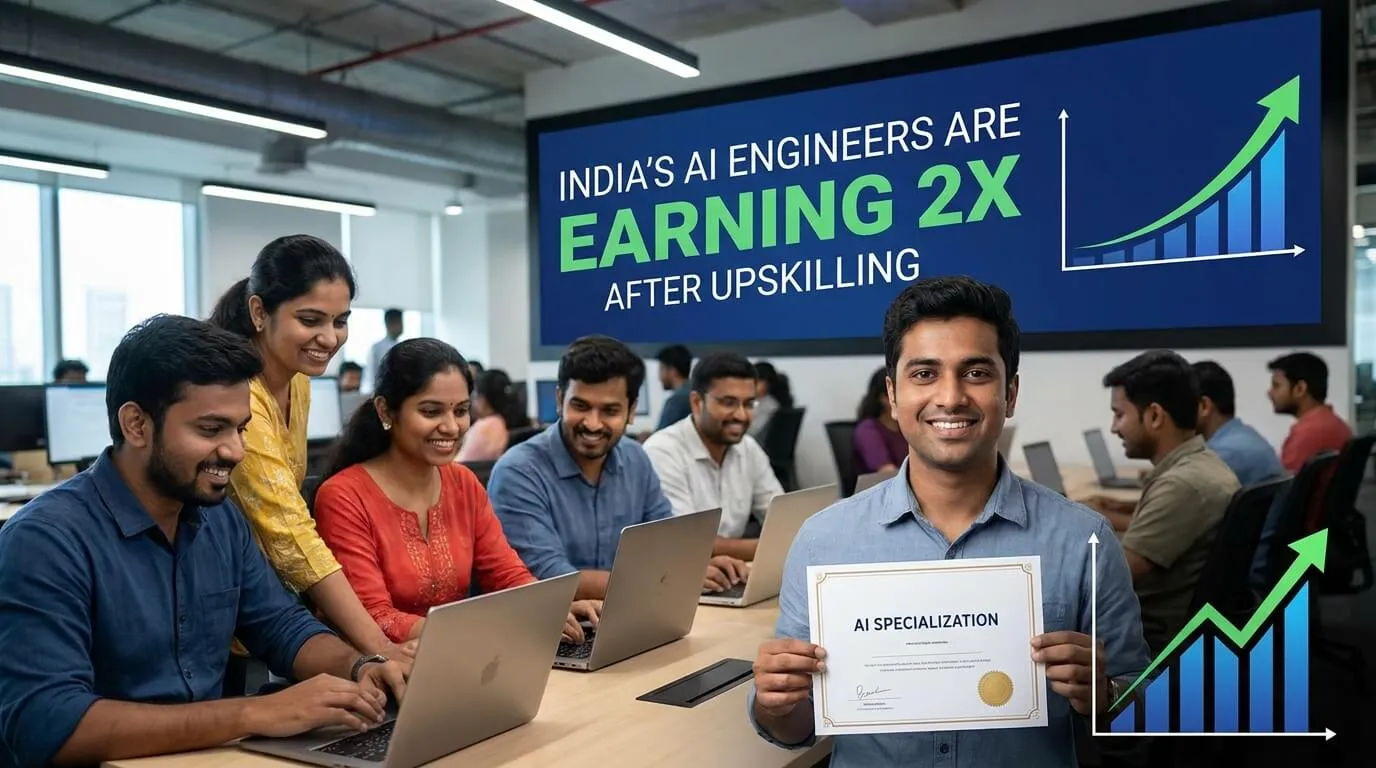
A study of 12,851 Indian engineers who completed structured AI upskilling programmes — verified by B2K Analytics, the same independent research firm that assesses placements for leading IIMs — found one outcome repeated consistently across the entire cohort: those who rebuilt their technical fundamentals for an AI-native market more than doubled their median salaries.
"Median post-programme CTC rose from ₹8.7 lakh to ₹20 lakh — a 104% jump. The average climbed 147%, pulled upward by a top quartile that crossed ₹45 lakh."
— B2K Analytics audit of 12,851 Scaler programme completers, 2023–2025This isn't a sample of ten engineers at one company. It's the largest independently verified salary dataset in India's tech upskilling space — and the numbers are reshaping how companies, students, and mid-career professionals think about AI readiness in 2026.
The salary shift didn't happen overnight. It began around 2023–24, when Indian companies — particularly product companies, fintech, and e-commerce — shifted their hiring criteria. It wasn't just about knowing Python any more. The market started distinguishing between engineers who could build AI systems that work in production and everyone else.
The gap was initially subtle. Then GenAI exploded in 2024. By early 2025, companies weren't just paying more for AI skills — they were paying dramatically less, or not hiring at all, for engineers who lacked them.
This is what the Scaler report calls a "repricing" of Indian AI talent. The market isn't just rewarding AI skills with a small bonus. It is resetting the entire salary band for technical talent based on AI readiness.
Software engineers with 3–5 years of experience in backend or full-stack development who add GenAI, MLOps, or NLP skills. The career context they bring — system design, production experience — combined with new AI skills is the most valuable combination in the market.
₹12L → ₹28–35L typical2025–26 graduates who pursued AI/ML specialisation alongside their degree — with real deployed projects on GitHub. They are not competing on the same salary scale as generalist CS graduates. Entry offers are starting ₹5–7L above their batch peers.
₹6L avg → ₹10–15L with AI skillsEngineers at TCS, Infosys, or Wipro who spent 2–3 years upskilling in AI on the side, built a portfolio, and made the switch to a product company or AI-native startup. The salary delta on this move alone is frequently ₹10–18 LPA.
₹9L → ₹22–30L at product cosEngineers who went deep on LLMs, RAG architectures, and AI agents — not just surface-level prompt engineering, but genuine LLM integration and deployment skills. This is currently the scarcest talent profile in India and commands the highest premium.
₹20–50L+ at senior levelThe data from the Scaler report is consistent with what hiring managers across India's tech sector have been saying for over a year: companies are not struggling to find people who know Python. They are struggling to find people who can build AI systems that stay alive in production and deliver measurable business value.
Before you start enrolling in every AI course available, the data deserves a more careful read. Not everyone who "upskills" doubles their salary. The engineers in this study completed structured programmes verified by independent assessors — not watched a few YouTube tutorials.
Can you build an end-to-end ML pipeline? Can you deploy a model as a REST API? Can you build a RAG application? If not, those are your gaps — not Python syntax or theoretical ML concepts you already know.
GenAI/LLM engineering, MLOps, or NLP. Not all three simultaneously. The salary premium comes from demonstrable depth in one area, not shallow exposure to all of them. The market rewards specialists far more than generalists at the ₹20L+ level.
An end-to-end ML pipeline with MLflow. A RAG application with a live Streamlit demo. A domain-specific classifier or NLP model deployed via FastAPI. These three projects — with clear READMEs, metrics, and GitHub links — will do more for your salary negotiation than any certification.
The gap between IT services and product companies at equivalent experience is 60–150%. If you are 2–3 years into your career at an IT services company, this is the most impactful single salary move available to you. Every year you delay this switch is roughly ₹3–5 LPA left on the table.
Bengaluru and Hyderabad pay 20–40% above the national average for equivalent AI roles. Even accounting for higher cost of living, the net financial gain from relocating to either city is typically positive within 6–12 months for mid-level engineers. Remote-first companies have narrowed — but not closed — this gap.
The Scaler report is one data point, but it sits inside a consistent pattern. NASSCOM, ETS, Glassdoor, and Scaler are all pointing at the same underlying reality: India's tech talent market is splitting into two cohorts — those who have adapted to an AI-native hiring environment and those who haven't.
The 89% of Indian professionals who say they are "building new skills" in the ETS report are right to be doing so. But the data from this verified study suggests that the outcome gap between structured, applied upskilling and passive certificate collection is massive — a difference between doubling your salary and not moving at all.
India is on track to need over 1 million AI professionals by 2026. The supply gap is real, the demand is structural, and the salary premium for genuine AI readiness is not a temporary bubble. For the Indian engineer who acts on this in the next 12 months, the window to capture the 2x outcome is still open — but it won't stay open indefinitely.